Here's the second part of my list of some times you might want to avoid a certain checkout line in the grocery store. Ever run into one of these?
The Red Tape Runaround
If you get close to the checker and happen to notice that her receipt tape has a large red stripe visible, find a new line if at all possible. The red line means that the tape is almost gone, and will probably run out before or during your turn at the register. Since the checkers must replace the tape before resuming their work, you are in for a long wait.
Inevitably, the checkstand will not have an extra roll of receipt tape in its storage area, so a manager must be summoned. When he learns that there is no extra tape at the checkstand, he will scowl because he knows the difficulty of the task before him. He will disappear for a full 10 minutes as he walks to the very back of the stockroom, then climbs up a ladder to a small shed on the far corner of the roof where these elusive rolls of tape seem to be stored. He will finally reappear, a little windblown, and toss the roll to the checker as he runs off to do another errand.
This is when you will discover that, of course, your checker, despite having worked at the store for three years, has never had to switch out one of these tapes herself. After five minutes spent fumbling with the rollers inside the register, cutting her fingers in the process, the checker will give up and call again for the manager, who is busy swimming through the store’s underground swamp to the small island guarded by alligators where the extra rolls of dimes and quarters are stored.
You get my point. If you see red, move along.
The Conversationalist
How you’ll take this next advice really depends on what kind of person you are – whether you are a person of few words who wants to get in and out of the grocery store as quickly and efficiently as possible, or if you are a person who goes to the grocery store partly out of a desire to be around other people and engage in interesting conversation.
If you’re the latter type of person, this advice doesn’t apply to you. But if you’re like me and you usually want to make the grocery store experience as brief as possible (within reason), then avoid the checker who treats each customer as one of their long-lost best friends at a high school reunion.
It’s not that these checkers are bad people. In fact, most are cheery and engaging and funny, and are quite popular with customers and management alike, as evidenced by the many “Checker of the Month” and “Best Employee” badges they wear pinned to their vests. They will likely ask -- no, demand -- your name, and there’s a good chance that if you return even weeks later and once again choose their line, they’ll remember that name and call you by it. If by chance they don't remember your name, they will be sure to call you "sweetie" or "hon" or some other generic endearment.
I must repeat that the talkative checker is many times a wonderful person to be around, but if you surrender to their charms you must give up any ideas of getting out of the store before your butter pecan ice cream melts. Their work method is something like this:
1. Introduce themselves, giving a summary of their early life, then find out your vital information (5 min.)
2. Scan two grocery items (20 sec.)
3. Discuss what both of you have been doing the past few weeks (8 min.)
4. Scan a few more items (45 sec.)
5. Ask about your children and listen to response (3 min.)
6. Make sure to give a summary of their child’s recent adventures on a school field trip (5 min.)
7. Scan a few more items (25 sec.)
Well, you get the picture.
There are some people who gladly wait a long time in line just to be checked out by these happy raconteurs of retail, and it’s a highlight of their week to be able to catch up on what Checker #5 at Wal-Mart has been up to. More power to these folks. It’s nice these days to have a little humanity mixed into the grocery store experience. But if you indeed don’t want that ice cream to melt, you might choose another line.
The Government-aided Shopper
First of all, let me say I have nothing against people whose economic status compels them to use government food programs like WIC to help them get the groceries they need to feed their families. They deserve our respect and help when it comes to trying to make ends meet.
All I’m saying is, because of the crazy way these government programs seem to work when it comes to checking out at the grocery store, you might want to avoid someone using a WIC or similar type card if you’re in a hurry. These cards apparently work like a debit card that keeps track of how much the person using them has in their account. And it seems that it’s sometimes a very difficult task for customers to remember just how much they have left on the card when they do their shopping.
As a result, what often times happens if this. The customer might choose, say, $120 worth of groceries, but after they give the WIC card to the checker and he swipes it through the machine, it indicates that there’s only $80 left of available funds on the customer's card.
Sometimes the customer will dispute this fact, requiring time to resolve the matter one way or the other, but even if they accept the fact that they only have $80 left to spend, your time in line behind them will drag on. You see, they must now look at all the food they originally selected (which often has to be un-bagged) and figure out which items they can do without to knock $40 off the total. This can take a very long time, as they consider leaving one item, then another, since many times all the food items in question are essentials and not frivolities.
There’s also the danger that one or more of the items the customer has selected are not “approved” for payment through the card (beer and cigarettes are just the two most obvious), so in this case there's often another dispute, or at least a delay, while those items are weeded out and the card is re-scanned.
Again, the problem usually lies in the cards themselves instead of the people who use them. But if you want to avoid a delay at checkout, you might choose another line.
The Wide-eyed Innocent
This final one is fairly self-evident. If you can see that your checker is a brand-new trainee (possibly even being trained right then by a hovering manager), then if you’re in a hurry you might want to choose another aisle. If you hear the manager explaining what the keys on the register are for, and how those little black lines on a package magically make the machine go "beep" when passed over it, you definitely want to switch aisles.
That's it for checking out. Coming up in my next and final post in the series – “Murphy’s Law” as applied to grocery shopping.
Showing posts with label Shopping. Show all posts
Showing posts with label Shopping. Show all posts
Tuesday, December 23, 2008


Thursday, December 18, 2008
The Grocery Store Chronicles: Checking Out (Part 1)
In my last post I discussed some of the types of shoppers it might be wise to avoid in the grocery store. Now, over two posts, I’d like to offer some hard-won advice as to when you might want to avoid a certain checkout lane in the grocery store and choose another instead. Here are some common situations and types of people to avoid.
The Coupon Queen
If you notice that one of the shoppers ahead of you in line –– usually a woman –– is carrying what looks like a Pony Express mail pouch full of clipped coupons, then move immediately to another aisle. It’s a good bet that this shopper will keep you waiting at least 30 minutes while they attempt to clear the cash register.
It’s not just that scanning all of those coupons takes time. Inevitably, there will be some sort of snafu that occurs. The scanner might refuse to accept a certain coupon for apple juice, so first the bagger must dig through the piles of already packed bags to find the beverage in question, then the information on the label must be examined and checked against the coupon. When it is discovered that the apple juice the customer purchased is the 48-ounce size, and the coupon only is good for the 64-ounce size or larger, then what ensues is either a debate between customer and checker on why the coupon should be accepted nevertheless (with a possible call for the manager to referee), or the bagger is sent out to the juice aisle to swap out bottles. When he returns minutes later, the next coupon is scanned, only to discover that it requires two tubes of biscuits to be purchased for the discount, not the single tube the customer has purchased. And so it goes.
If you want to avoid a long wait, pass by the coupon queen.
The Lovers
Stay clear of any checkout line where the person doing the checking and the person doing the bagging seem to be infatuated with each other. When a young man or woman’s fancy turns to love, it’s a good bet that they’ll be so taken with the subject that they won’t notice they scanned your bag of peas twice, or absentmindely put the 20-pound bag of dog food on top of your carton of eggs in the basket.
A common example of this kind of cashier team is where the cashier is a teenaged girl, teamed with a teenaged boy bagger who is clearly infatuated with her and trying his best to win her over. He will talk almost nonstop to her, cracking jokes, making sarcastic remarks and asking questions. The girl will be forced to listen and respond (to be polite) and as a result, neither checker or bagger is even really looking at the products they are scanning and putting away. Besides slowing down the whole process, this can lead to incorrectly scanned items, improper bagging and a host of other annoyances.
In one memorable event, I once checked out at a grocery store, with a full cart of groceries, and neither the checker nor the bagger spoke once to me, or even looked at me, because they were so deeply involved in flirtatious talk. They were like robots attuned to some common frequency, just going through the motions of moving groceries down the counter out of habit. I could have been buck naked, wearing a sombrero on my head with illuminated Christmas lights wrapped around my body, and they wouldn’t have even noticed.
(If you read that last sentence just after eating a big meal, or after decorating your Christmas tree, I apologize).
The Clothes Buyer
If you are shopping in a store like a Super Target or Super Wal-Mart that sells both groceries and clothing, and someone ahead of you in line has a pile of clothing they are buying, there are even odds that you’ll avoid a long delay by moving to another line.
The problem is that, inevitably, one or more of the items of clothing the customer wants to buy has had the tag removed somehow. Since the checker can’t scan the item’s price in without a tag –- let’s say for purposes of illustration it's a woman’s dress -- this means that someone, usually a pimply teenaged bagging boy with no clue as to women’s clothing, is dispatched to the women’s department to try and find the dress with the tag, or at the very least determine the item's correct price. After 20 minutes or so, he returns and gives the checker the bad news. Either (1) he couldn’t find where those dresses were located, (2) he found where the dresses were, but the one in question is apparently the very last one, or (3) there are other dresses like this, but they don’t have tags, either.
When it comes to clothing, there is no end to the possibly delays. Sometimes the clothing item has a tag, but the shopper notices only at the checkout line that the item is ripped or stained, and then the same pimply faced boy must be sent to find a replacement.
Take my advice – find another line.
NEXT POST: We'll meet The Conversationalist and learn to avoid the "Red Tape Runaround."
The Coupon Queen
If you notice that one of the shoppers ahead of you in line –– usually a woman –– is carrying what looks like a Pony Express mail pouch full of clipped coupons, then move immediately to another aisle. It’s a good bet that this shopper will keep you waiting at least 30 minutes while they attempt to clear the cash register.
It’s not just that scanning all of those coupons takes time. Inevitably, there will be some sort of snafu that occurs. The scanner might refuse to accept a certain coupon for apple juice, so first the bagger must dig through the piles of already packed bags to find the beverage in question, then the information on the label must be examined and checked against the coupon. When it is discovered that the apple juice the customer purchased is the 48-ounce size, and the coupon only is good for the 64-ounce size or larger, then what ensues is either a debate between customer and checker on why the coupon should be accepted nevertheless (with a possible call for the manager to referee), or the bagger is sent out to the juice aisle to swap out bottles. When he returns minutes later, the next coupon is scanned, only to discover that it requires two tubes of biscuits to be purchased for the discount, not the single tube the customer has purchased. And so it goes.
If you want to avoid a long wait, pass by the coupon queen.
The Lovers
Stay clear of any checkout line where the person doing the checking and the person doing the bagging seem to be infatuated with each other. When a young man or woman’s fancy turns to love, it’s a good bet that they’ll be so taken with the subject that they won’t notice they scanned your bag of peas twice, or absentmindely put the 20-pound bag of dog food on top of your carton of eggs in the basket.
A common example of this kind of cashier team is where the cashier is a teenaged girl, teamed with a teenaged boy bagger who is clearly infatuated with her and trying his best to win her over. He will talk almost nonstop to her, cracking jokes, making sarcastic remarks and asking questions. The girl will be forced to listen and respond (to be polite) and as a result, neither checker or bagger is even really looking at the products they are scanning and putting away. Besides slowing down the whole process, this can lead to incorrectly scanned items, improper bagging and a host of other annoyances.
In one memorable event, I once checked out at a grocery store, with a full cart of groceries, and neither the checker nor the bagger spoke once to me, or even looked at me, because they were so deeply involved in flirtatious talk. They were like robots attuned to some common frequency, just going through the motions of moving groceries down the counter out of habit. I could have been buck naked, wearing a sombrero on my head with illuminated Christmas lights wrapped around my body, and they wouldn’t have even noticed.
(If you read that last sentence just after eating a big meal, or after decorating your Christmas tree, I apologize).
The Clothes Buyer
If you are shopping in a store like a Super Target or Super Wal-Mart that sells both groceries and clothing, and someone ahead of you in line has a pile of clothing they are buying, there are even odds that you’ll avoid a long delay by moving to another line.
The problem is that, inevitably, one or more of the items of clothing the customer wants to buy has had the tag removed somehow. Since the checker can’t scan the item’s price in without a tag –- let’s say for purposes of illustration it's a woman’s dress -- this means that someone, usually a pimply teenaged bagging boy with no clue as to women’s clothing, is dispatched to the women’s department to try and find the dress with the tag, or at the very least determine the item's correct price. After 20 minutes or so, he returns and gives the checker the bad news. Either (1) he couldn’t find where those dresses were located, (2) he found where the dresses were, but the one in question is apparently the very last one, or (3) there are other dresses like this, but they don’t have tags, either.
When it comes to clothing, there is no end to the possibly delays. Sometimes the clothing item has a tag, but the shopper notices only at the checkout line that the item is ripped or stained, and then the same pimply faced boy must be sent to find a replacement.
Take my advice – find another line.
NEXT POST: We'll meet The Conversationalist and learn to avoid the "Red Tape Runaround."
Tuesday, November 18, 2008
The Grocery Store Chronicles: Shoppers
 When you commandeer a metal shopping cart (with a wobbly right front wheel, no doubt) and head into your local grocery store, you join many of your friends and neighbors who are also trying to get in and out with the least possible trouble. Most of these shoppers will be like you -- calm. collected and considerate, aware of their goals and trying to get their shopping done quickly and efficiently, but not so fast that they endanger the lives or sanity of those around them.
And then, of course, there are the other people. Here's a short list of some of the notable types of grocery buyers I have observed that make shopping hazardous -- or at least more interesting.
THE PROFESSORS
 Most of us come to the grocery store with at least one or two items we're not sure about. Maybe it's some new cereal our kids have begged us to get, and we have to really search the shelves to find it because we've never seen the name or the packaging before. Maybe a recipe calls for some exotic type of fruit or vegetable that we've never once used, or even eaten, and we're not exactly sure which section of the produce department it's located in.
As I said, it's normal to have a few items on the list that require us to do a little more searching than usual. But for some grocery shoppers, the ones I call "the professors," even the simplest purchases require a lengthy session of on-site research.
You might meet a professor in front of the yogurt case. As you patiently wait for him to move aside to allow you access, you notice that he is involved in an intense lab experiment regarding the visual forms and scientific qualities of cultured milkfat products. He will methodically pick up each and every carton of yogurt, examining the calories, fat and sugar content, checking for the presence of preservatives, detecting if the milk used came from cows not fed growth hormone, and making sure the company has listed a 1-800 number on the carton in case of complaints.
After each carton of yogurt has been individually inspected (phase one of the research), then the comparison phase begins. The professor will grab two different cartons of yogurt, turn them so their product information panels are showing, and then compare each to the other to determine which of the two has an overall higher rating of nutritional acceptability. Yogurt A has lower overall calories, but Yogurt B has fewer grams of sugar. Hmmmm. Let's set both aside and then compare C and D.
And on and on and on it goes. By the time the professor has decided on his two cartons of yogurt, he has examined all 256 varieties in the case, and probably has enough information to write a short article (with footnotes) for Dairy Product Research Journal.
Of course, if the professor stands in front of the yogurt so that you can't get to your four cartons of Yoplait vanilla, you will either have to come back in half an hour, or say "excuse me" as you lunge past him to grab your goods. Go ahead and do this, because he's used to it. Researchers call this "encountering variables in the field."
THE CLUELESS
 On the opposite pole from over-involved shoppers are those who don't have the first idea what they're doing. One can usually spot a member of "The Clueless" by their glazed expression and seeming total lack of comprehension when they enter the four walls of a supermarket.
Who are the clueless? In most cases, from what I have seen, they are men. I suppose these are guys who visit the inside of a grocery store about as often as they enter the Oval Office to chat with the President. Some of them are older men who probably last entered a grocery store back when produce was sold from barrels and the manager wore a pinstriped apron and handed out penny candy to little girls in pinafores.
Undoubtedly, some great disturbance in the Force, or some temporal rift in the cosmos of his existence, has forced Mr. Clueless out of his comfort zone and to the store. Maybe his wife just got hit by a truck and is laid up in bed with a dozen broken bones, preventing her from performing her wifely duty of slogging to the supermarket. Or maybe his wife finally left for good weeks ago, and after doggedly eating through all the old cans of Spaghetti Os and the wormy packages of Ramen noodles at the back of the pantry, he is forced to find new nourishment or starve to death. Maybe he drew the short straw at the Friday night poker game and is forced to make the grocery run alone. There are lots of possible scenarios.
Whatever the reason, Mr. Clueless can be spotted easily by his wide eyes, gaping mouth and slow, almost shuffling gait. The last time this guy went grocery shopping the store had three aisles and two checkout stands. Now, he is entering a space the size of an aircraft hangar that has 36 aisles, 15 checkout lanes and seven separate departments, and is as busy as a big city commuter train station at rush hour.
When he starts trying to find the items his wife has written down on his list, he discovers how American wealth and ingenuity have made shopping insanely complex these days. For example, the list Mr. Clueless holds instructs him to return home with "Grape jelly." After wandering around the store for awhile he (by some miracle) finds himself in front of the jelly section. But when he goes to find grape jelly, what does he discover? That there are at least 30 different jars that might fill the bill. There are 20 different brands of grape jelly, and 10 brands of something called "grape jam," which looks like grape jelly but isn't, somehow. Even if he sticks to grape jelly, should he get the "regular" kind, the "low sugar" kind, the "organic" kind, the "organic low sugar" kind, or the "fruit only" kind? Should he even bother with a name brand at all, or just get the store brand -- or a plain label generic? And what size jar should he get? Is the 5 ounce size too small? Is the 24 ounce size too large?
This maddening variety confronts poor Mr. Clueless at every turn. His wife has written down, "1 doz. eggs." He visits the egg case to find, again, an incredible array of choices. Should he get medium, large, extra large or jumbo size eggs? Should they be white, or brown? Does he want "regular" eggs, or "cage free," or "free range?" Should he get the ones with something called "Omega 3" added?
If Mr. Clueless remembered to bring a cell phone, you will often find him in continuous contact with the Mother Ship as he picks up each product possibility and reads the pertinent information off. You'll then hear him rattle off a disjointed string of responses like, "No, there isn't a blue colored label, it's a purple one." "No, I don't see one that says 'with bleach.' There's 'extra strength' and 'lemon scented,' but none 'with bleach.'" "No, they don't have vanilla flavor in the 24 ounce box, just in the 16 ounce. Yes, I looked in the back of the shelf." And so on and so on, shelf after shelf, aisle after aisle.
When I see Mr. Clueless looking up in open-mouthed panic at a wall of breakfast cereals stretching half a city block, I am tempted to give the guy a reassuring pat on the shoulder and say, "I know what you're feeling. Let me help you." But I usually don't have time, and besides, in some cities this is probably considered a pickup line.
THE SOCIAL BUTTERFLIES
 You all have seen this next grocery shopper many times, I am sure. As you head down the narrow aisle of condiments, sauces and marinades, you notice that your way is blocked by two carts, going in opposite directions, which have been brought to a halt together near the French's mustard. The owners of each cart (usually women this time, but not always) have temporarily abandoned their shopping and are standing close together in the middle of the aisle, talking. And talking. And talking.
The first trait that defines the social butterfly shopper is an affinity for gossip (which they will call something less negative, such as "catching up"). These people come to the supermarket, in part, to hear and be heard. They know at least half of the customers at any one time, or so it seems, and they are loath to pass up the chance to chat up any of them if it means they might hear some previously unknown news.
The second trait that defines the social butterfly shopper is obliviousness. While they are talking with a friend in the aisle, or chatting on a cell phone as they stand in front of the dairy case, they are totally focused on the conversation at hand. They do not see you and the 12 other shoppers lined up on either side of them, waiting to get by. They do not notice that if they moved just a foot or two to the left or the right, they would allow you and others to reach the items on the shelf behind them. They are not aware that their unsupervised children are running down the aisles, removing groceries from the shelves and making a general nuisance of themselves. They are totally focused on talking, and if you are so rude as to try to move their cart a bit to one side or the other, or to reach past them to get an item, they will often shoot you a glance as if you deserved to have slivers of bamboo inserted under your toenails for your cheeky presumption.
Sometimes the social butterfly shopper is a friend of yours, and this makes it a challenge when they stop you on your way to the checkout (with lots of cold items slowly melting in your cart) and begin conducting a thorough interrogation about you, your family and mutual friends, as well as providing you with a detailed accounting of their own life. If you have time to spare, this might be an enjoyable encounter. If you're in a hurry, you might want to duck down the housewares aisle if you see the social butterfly shopper approaching in your direction.
That's a little about three types of interesting shoppers you might find in the grocery. Next post, we'll look at what to avoid when choosing a checkout aisle.
Thursday, November 13, 2008
The Grocery Store Chronicles: Introduction
 I'm a bit of an aberration, I suppose, in that I am a married, heterosexual male who enjoys grocery shopping -- or, who at least does not despise it as much as most men nowadays seem to.
I started grocery shopping when I was a carefree bachelor buying cheap canned meats and snack foods in college. I kept it up during my single days as a member of the workforce, then after I married I continued grocery shopping because, well, my wife wasn't all that thrilled with the task, and I seemed not to mind it. So, as a gift to her, I offered to roam the aisles each week.
One reason I don't usually mind grocery shopping is that I like to cook, and I enjoy trying new recipes (even if they are simply new "recipes" that have to be heated up or mixed up from a can or box). I spend at least a part of each grocery trip browsing the shelves to see what new, ingenious items have been introduced. You can get burned out on a dish pretty quickly, so it pays to find new things that seem promising to the palate.
Of course, now that the huge superstores I buy food in also sell things like books and DVDs, I spend some of my time in the store browsing among the new titles.
In my more than 25 years as a grocery shopper I have learned a lot about the practice, and about the different types of people -- customers and employees -- that can be found in the modern supermarket. In the next few days I plan to present a series of posts relating some of my hard-fought grocery wisdom. I hope you enjoy them.
Wednesday, January 10, 2007
My Checkout Lane Fantasies
I might have mentioned on this blog before that I do most of the grocery shopping for the Muley family. I know this is somewhat unusual for a married guy to admit, but since I like to cook, and I like to experiment with new recipes, and most of the time I really enjoy grocery shopping (or at least don't hate it as much as most guys do), I try to pull my weight and help Mrs Muley with the chores by offering to buy the groceries.
I tell you all this only as an introduction. During my frequent trips to buy groceries, at both a huge "Mart-type" store as well as a huge chain grocery store, I have noticed that all of the checkers ask each customer the same thing at the beginning of the checkout process: "Did you find everything that you need?"
Every single time, even when I have been unable to locate a number of items, either because they don't carry that brand, or are just temporarily out, I invariably smile (and lie) by responding, "Yes." And I have never heard another customer ever do anything else except say "Yes," too, when that question was asked.
I am sure that all of these checkers are not asking this same question by random chance. Undoubtedly, they have been instructed by the management to ask this of every poor sap who wheels his cart up to the line. But lately I have begun to wonder: WHY are these checkers told to ask this? What is the purpose?
I mean, let's say a customer approaches the checkout line, begins unloading groceries, is asked, "Did you find everything that you need?," and answers, "No, in fact, I was looking for the Porky Pie Farms 32-ounce jar of pickled pig's feet, and you're all out"? What would happen next?
My guess is that the sullen 18-year-old checker girl with the tattoos and the lip piercings would then just stare at the customer silently for a few seconds before replying, "Oh...bummer," before resuming dragging the food across the scanner. Or maybe she would ask one of the 18-year-old stockboys with the permanently attached blaring iPod to go look for the missing item, after which he would report back on its absence, followed by the checker replying,"Oh...bummer."
That's probably what would happen, but that's boring. My imagination has come up with some wonderful things that could happen when I said items were missing (if this were a perfect world):
1. A rotating light on the checkstand begins flashing, like the ones on Las Vegas slot machines, and the store manager comes up to me, gives me a crisp $100 bill, and explains it is the company's "Thanks For Telling the Truth" gift. He then takes my name and enters me in a drawing to win a dream home, a Hawaiian vacation and a guest starring role on "CSI."
2. The manager comes up, apologizes profusely for not having the item in stock, then pulls up his shirt and says, "Okay, look, hit me as hard as you want. I deserve it. No, come on, I can take it. Hit me a good one, right in the ol' gut."
3. The store manager comes out, apologizes profusely for not having the item, then offers me psychological counseling free of charge to help me deal with any feelings of distress or loss I might be experiencing. If I agree, I am guided to a small, plush room in back of the management offices, where a smiling psychologist has me lie on a couch while asking me to "share my pain" and "express my anger without fear of communal reprisal." If I seem to tear up a bit, I am offered my choice of day-old bakery items free of charge.
4. When the manager determines what department of the store the missing item is in, the supervisor of that department is quickly summoned to the front, and an announcement is made over the loudspeaker that "a punishment session will take place in five minutes next to the green vegetables." All the customers rush to where a portable stage has quickly been assembled. If this is the supervisor's first or second offense, he or she is let off with a light flogging, issued by a large woman dressed in a leather bustier and face mask, brandishing a thick bullwhip. If this is the department supervisor's third offense, a group of stockboys is issued loaded rifes and the offender is executed by firing squad (after punching out on the time clock, of course).
5. The last one is my ultimate fantasy. When I tell the checker about the item I could not find, she pushes a large red button under her register, and many things happen simultaneously: the doors into and out of the store automatically close tight, sirens begin to wail, primary lighting is shut off, and a voice over the loudspeaker blares, "This is an emergency product lockdown. I repeat, this is an emergency product lockdown. Everyone remain still until further notice."
At the same time, a message goes out to the company's main regional distribution center, listing the store number and the name and UPC product code of the missing item. Within seconds, the computer retrieval system drops the item on a conveyer belt and delivers it to a team of waiting store personnel dressed in emergency flight suits and survival gear. They hop into a helicopter waiting on a nearby helipad, and within minutes they fly to the store and land on the roof.
As I watch, amazed, a skylight opens above the checkout line where I still stand, a rope is dropped, and a man rappels down, landing directly in front of me. He bends down, kisses my feet repeatedly, then gets up and hands me my 32-ounce jar of pig's feet.
Before being pulled back up to his waiting helicopter, he looks me straight in the eyes and asks, "Sir, was there anything else you couldn't find today?"
And I say, "Well, there was this new brand of fat-free yogurt I'd heard about..."
I tell you all this only as an introduction. During my frequent trips to buy groceries, at both a huge "Mart-type" store as well as a huge chain grocery store, I have noticed that all of the checkers ask each customer the same thing at the beginning of the checkout process: "Did you find everything that you need?"
Every single time, even when I have been unable to locate a number of items, either because they don't carry that brand, or are just temporarily out, I invariably smile (and lie) by responding, "Yes." And I have never heard another customer ever do anything else except say "Yes," too, when that question was asked.
I am sure that all of these checkers are not asking this same question by random chance. Undoubtedly, they have been instructed by the management to ask this of every poor sap who wheels his cart up to the line. But lately I have begun to wonder: WHY are these checkers told to ask this? What is the purpose?
I mean, let's say a customer approaches the checkout line, begins unloading groceries, is asked, "Did you find everything that you need?," and answers, "No, in fact, I was looking for the Porky Pie Farms 32-ounce jar of pickled pig's feet, and you're all out"? What would happen next?
My guess is that the sullen 18-year-old checker girl with the tattoos and the lip piercings would then just stare at the customer silently for a few seconds before replying, "Oh...bummer," before resuming dragging the food across the scanner. Or maybe she would ask one of the 18-year-old stockboys with the permanently attached blaring iPod to go look for the missing item, after which he would report back on its absence, followed by the checker replying,"Oh...bummer."
That's probably what would happen, but that's boring. My imagination has come up with some wonderful things that could happen when I said items were missing (if this were a perfect world):
1. A rotating light on the checkstand begins flashing, like the ones on Las Vegas slot machines, and the store manager comes up to me, gives me a crisp $100 bill, and explains it is the company's "Thanks For Telling the Truth" gift. He then takes my name and enters me in a drawing to win a dream home, a Hawaiian vacation and a guest starring role on "CSI."
2. The manager comes up, apologizes profusely for not having the item in stock, then pulls up his shirt and says, "Okay, look, hit me as hard as you want. I deserve it. No, come on, I can take it. Hit me a good one, right in the ol' gut."
3. The store manager comes out, apologizes profusely for not having the item, then offers me psychological counseling free of charge to help me deal with any feelings of distress or loss I might be experiencing. If I agree, I am guided to a small, plush room in back of the management offices, where a smiling psychologist has me lie on a couch while asking me to "share my pain" and "express my anger without fear of communal reprisal." If I seem to tear up a bit, I am offered my choice of day-old bakery items free of charge.
4. When the manager determines what department of the store the missing item is in, the supervisor of that department is quickly summoned to the front, and an announcement is made over the loudspeaker that "a punishment session will take place in five minutes next to the green vegetables." All the customers rush to where a portable stage has quickly been assembled. If this is the supervisor's first or second offense, he or she is let off with a light flogging, issued by a large woman dressed in a leather bustier and face mask, brandishing a thick bullwhip. If this is the department supervisor's third offense, a group of stockboys is issued loaded rifes and the offender is executed by firing squad (after punching out on the time clock, of course).
5. The last one is my ultimate fantasy. When I tell the checker about the item I could not find, she pushes a large red button under her register, and many things happen simultaneously: the doors into and out of the store automatically close tight, sirens begin to wail, primary lighting is shut off, and a voice over the loudspeaker blares, "This is an emergency product lockdown. I repeat, this is an emergency product lockdown. Everyone remain still until further notice."
At the same time, a message goes out to the company's main regional distribution center, listing the store number and the name and UPC product code of the missing item. Within seconds, the computer retrieval system drops the item on a conveyer belt and delivers it to a team of waiting store personnel dressed in emergency flight suits and survival gear. They hop into a helicopter waiting on a nearby helipad, and within minutes they fly to the store and land on the roof.
As I watch, amazed, a skylight opens above the checkout line where I still stand, a rope is dropped, and a man rappels down, landing directly in front of me. He bends down, kisses my feet repeatedly, then gets up and hands me my 32-ounce jar of pig's feet.
Before being pulled back up to his waiting helicopter, he looks me straight in the eyes and asks, "Sir, was there anything else you couldn't find today?"
And I say, "Well, there was this new brand of fat-free yogurt I'd heard about..."
Wednesday, May 03, 2006
Random Observations and Trivial Events
 1. What do you think when you see a place of business sporting a sign that says “under new manage- ment?” Does it inspire a positive response in you? My feeling is that the only businesses that display such a sign are ones that have gained quite a bad reputation, either for bad service, bad products or both. I mean, if a successful business had built up a sterling reputation in the community, the last thing a smart new owner would want to do is to let people know the management had changed, for fear that they would begin to have doubts about whether the quality would continue. Right? In short, the only business owners wanting to advertise a change in management are the ones who sincerely hope those past unpleasant incidents with food poisoning or sexual misconduct or police raids will soon be forgotten.
2. Once a year, the City of Waco graciously holds something called a “Hazardous Waste Day,” where you can haul down all the stuff they deem hazardous – old paint cans, old batteries, unused lighter fluid, motor oil, etc. – and dump it for no charge. My question is, why do they only have these special days once a year? Yes, I imagine they cost the city money, but do they think people wait patiently for an entire year before throwing away things like old paint and oil? Sheesh, no. If there’s not an easy way of disposing of it safely, then we will likely toss it in the weekly garbage, where it will be taken to the landfill, and cost a lot more in the long run in terms of trash, cancer-causing agents and the underground creation of large, radioactive monsters that arise from the dump and wreak havoc on surrounding suburbs.
3. Here on campus I see all these college students looking bleary-eyed lately, and I know they are high on caffeine and going without sleep studying for finals. For all I know, it’s the first time they’ve studied all semester. I remember the stress and fear that came with finals, and I’m tempted to really feel sorry for the students, but then I remember that after a week of taking tests, they’ve got three months to basically sleep in late, party and do nothing they don’t want to do. Let ‘em suffer awhile, I say.
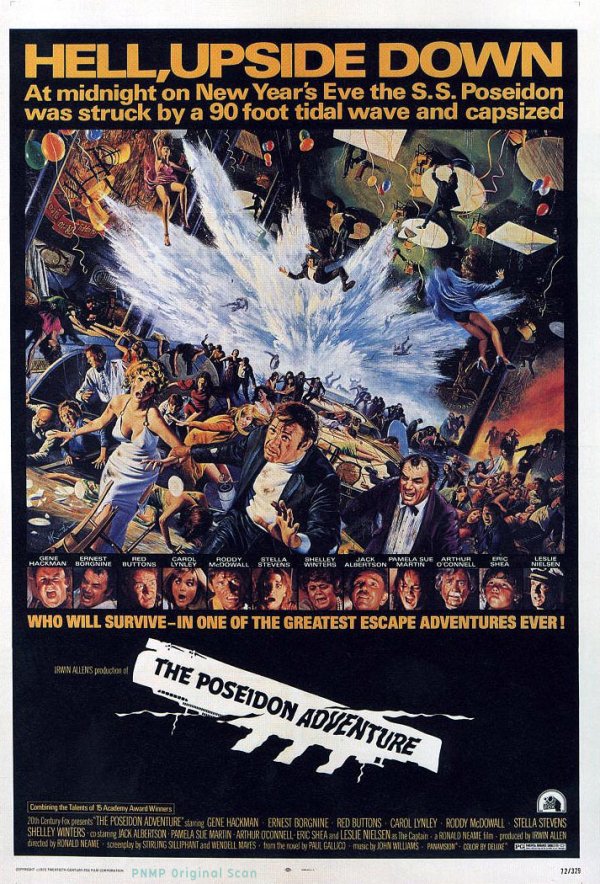 4. I know this probably sounds goofy, but I’ve seen the trailer for the new “Poseidon Adventure” movie (a re-make) that’s opening this month, and I want to see it. The original movie (the one where Shelley Winters constantly got stuck and Ernest Borgnine complained all the way through) was one of my favorites as a kid.
5. I was behind a college student at the convenience store the other day, and I noticed that she bought one item – a large bottled water – and paid for it with a credit card. I thought, this says something about modern society in a nutshell. We’re paying for things like water that we could easily get for free, and to do it, we’re in effect borrowing money from a bank at interest. I’ve done this before, too (with Dr Pepper, of course), so I’m not exempt.
6. I have been unable to finish a book, cover to cover, these last two or three months. Some books I have gotten almost all the way through, some I have gotten to the end of only by skipping big parts in the middle, and some I’ve abandoned after only a few chapters. But there's not one book I have read every word of. A lot of these were great books, classics, ones I was excited about reading, so I can’t blame the material. What is my problem?
7. On second thought, don't answer that.
Today’s quote:
”Do you think we should drive a stake through his heart just in case?”
--Actor Peter Lorre, to Vincent Price at Bela Lugosi’s funeral
Subscribe to:
Posts (Atom)